Project Mirage has introduced Dune, a compact programmable keypad designed to streamline workflows on MacBooks by providing context-aware hardware shortcuts that automatically adapt to the application currently in use.
The USB-C accessory combines customizable physical controls with AI-assisted automation, targeting professionals who frequently switch between video conferencing, productivity software, development tools and web applications.
Adaptive Hardware for Everyday Workflows
Unlike conventional macro keypads that require fixed button assignments, Dune dynamically changes its functions based on the active application.
In video conferencing platforms, the three programmable keys can control microphone muting, camera activation and window management. When users switch to spreadsheet software, the same buttons can perform operations such as copy, paste and undo. Browser shortcuts, coding commands and development workflows can also be assigned automatically.
The context-sensitive approach reduces the need to memorize keyboard shortcuts across multiple applications while providing dedicated physical controls for frequently used functions.
Compact Engineering
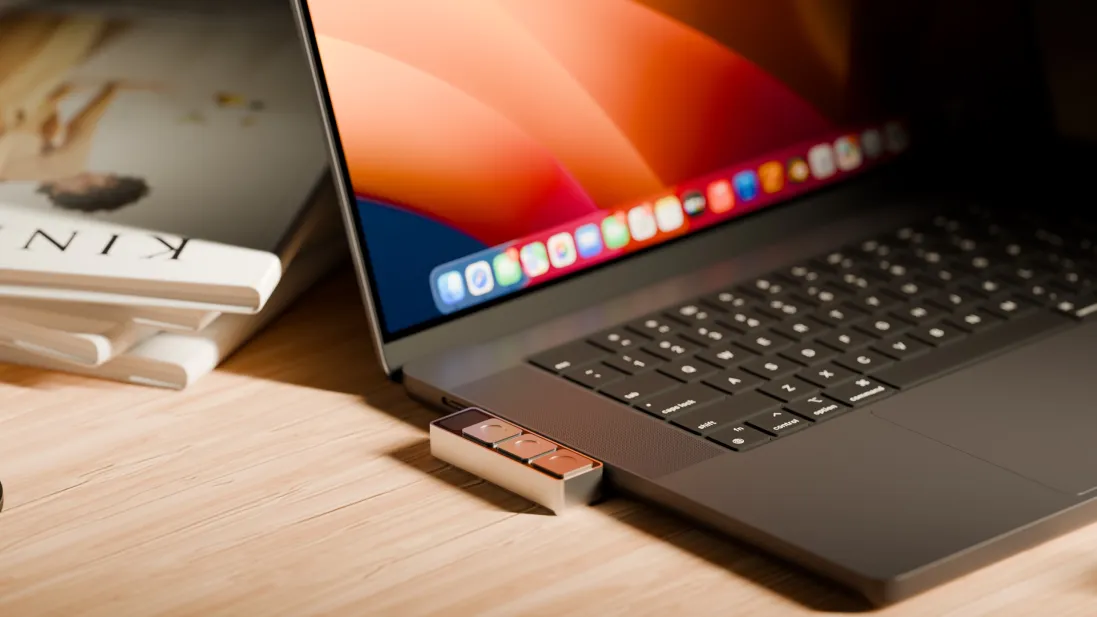
Approximately the size of a stick of chewing gum, Dune connects directly to a MacBook's USB-C port without requiring batteries or external power supplies.
Project Mirage manufactures each unit to match specific MacBook models, allowing the aluminum enclosure to sit flush against the side of the laptop. Users whose USB-C ports are already occupied can also connect the device through a compatible hub or adapter.
Current compatibility includes MacBook Air models powered by Apple's M2 processor or newer, along with MacBook Pro systems using M1 Pro processors and later generations running macOS Sequoia or newer.
AI-Assisted Customization
Configuration is handled through a companion application that allows users to assign shortcuts on either a per-application or system-wide basis.
Each key can execute keyboard shortcuts, launch applications, open URLs or perform custom commands.

For advanced automation, the software supports Python scripting, enabling technically inclined users to build complex workflows.
The platform also integrates with Claude Desktop, allowing users to describe desired automations in natural language. Claude generates the corresponding script and maps it to a hardware button, reducing the amount of manual configuration required for customized workflows.
Productivity Features Beyond Shortcuts
The companion software extends beyond key mapping by integrating with the user's calendar.
Upcoming meetings can be displayed shortly before they begin, allowing users to join calls, dismiss reminders or send predefined status messages directly from the keypad.
Project Mirage has also introduced an online marketplace where users can share custom automation routines, creating a growing ecosystem of reusable productivity tools.
While the marketplace currently offers a limited selection of downloadable functions, the company sees community-developed automations as an important part of the platform's long-term expansion.
Human-Centered Interface Design
Dune reflects a broader trend toward specialized human-machine interfaces that combine dedicated hardware with software intelligence.
Rather than replacing traditional keyboards, the device serves as a contextual input layer designed to reduce repetitive interactions and improve workflow efficiency across multiple professional applications.
As AI-powered automation becomes increasingly integrated into desktop computing, hardware interfaces such as Dune illustrate how compact programmable devices can bridge physical controls with intelligent software, creating more adaptive and personalized computing experiences for productivity-focused users.



 Reviewed by Untung
on
01.13
Rating:
Reviewed by Untung
on
01.13
Rating:


Tidak ada komentar: